
Your business might look good on Facebook, the choice between Facebook or website isn’t just a matter of preference—it’s essential for growth.
I’ve uncovered seven reasons why relying only on Facebook is a risk, and one of them could be fatal to your business.
Ready to protect your online presence? Discover why a website is the key to your long-term success.
What to expect?
Prefer to watch a video instead?

Before diving in, let’s get straight: having a Facebook page is still crucial for your business. But relying on it alone? That’s like bringing a knife to a gunfight.
You’re about to discover why diversifying your online presence is not just brilliant – essential for survival in today’s digital era.
So, why is a Facebook page alone not enough and actually risky?
1. Not everyone is on Facebook.
Even though there are 3 billion monthly active Facebook users, that’s still less than half of the global population. Yeah, let that sink in for a moment.
And, here’s what you should definitely take note of…
Almost half of the US population aren’t Facebook users, which I find surprising because in Canada, 82% of us are Facebook users.
This isn’t just a statistic – it’s a wake-up call. If you rely solely on Facebook to reach your audience, you’re missing out on a massive chunk of the market. And in business, we all know that missed opportunities equal missed revenue.
Now, let’s dive into a real-world example, shall we?
Say you’re a dog owner and desperately searching for a pet groomer. You stumble upon K9 Design Studio, a charming business in the land down under. (In this example, you’re Australian.)
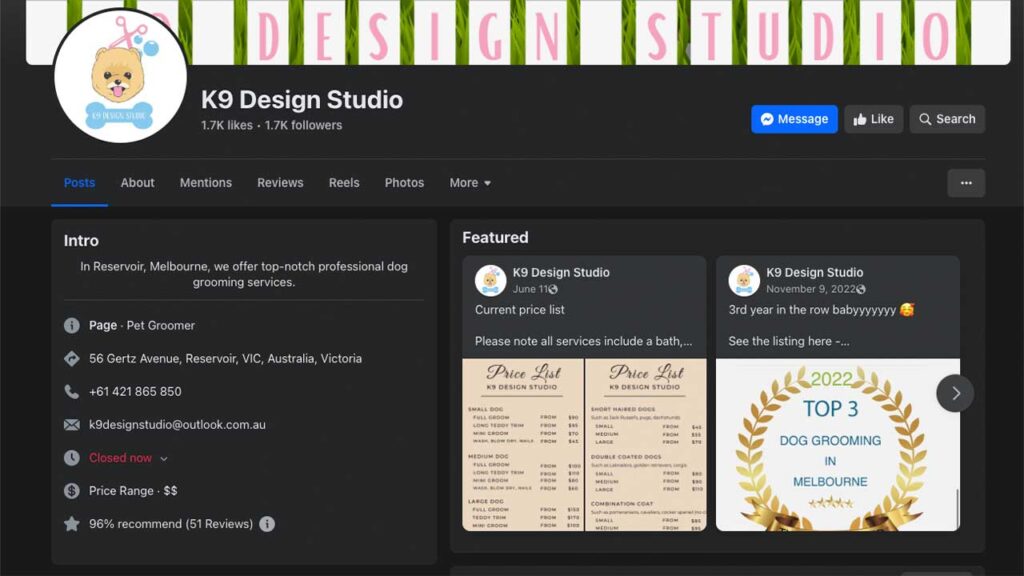
Sounds perfect, right?
Well, not so fast.
If you’re not on Facebook, here’s what you’ll see:
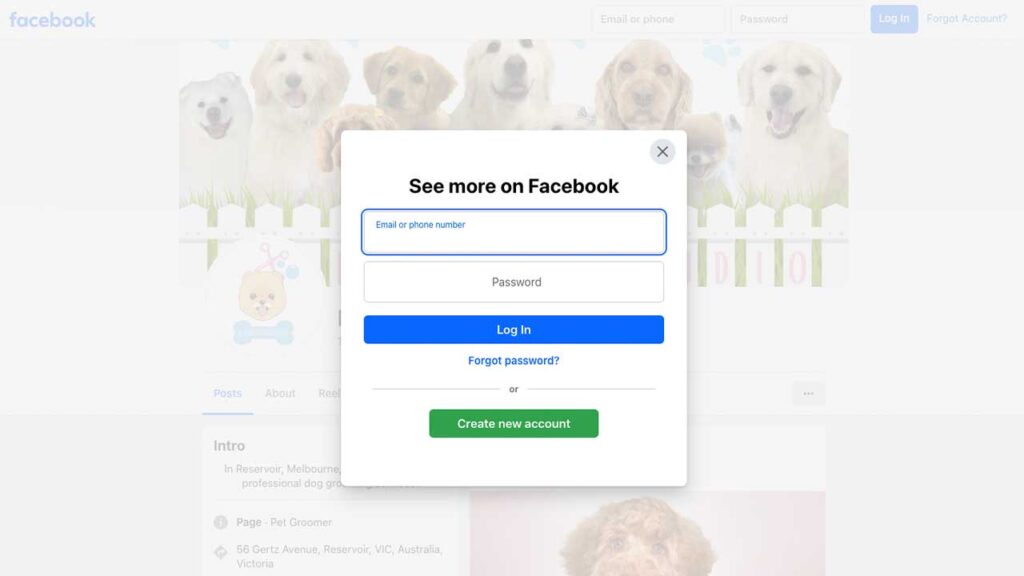
A digital brick wall.
That’s right; you’re met with a login screen demanding that you either sign up or log in. Talk about a mood killer!
Suppose you’re busy, even in a hurry. Are you really going to stop everything to create a Facebook account to see if this pet groomer is worth your time?
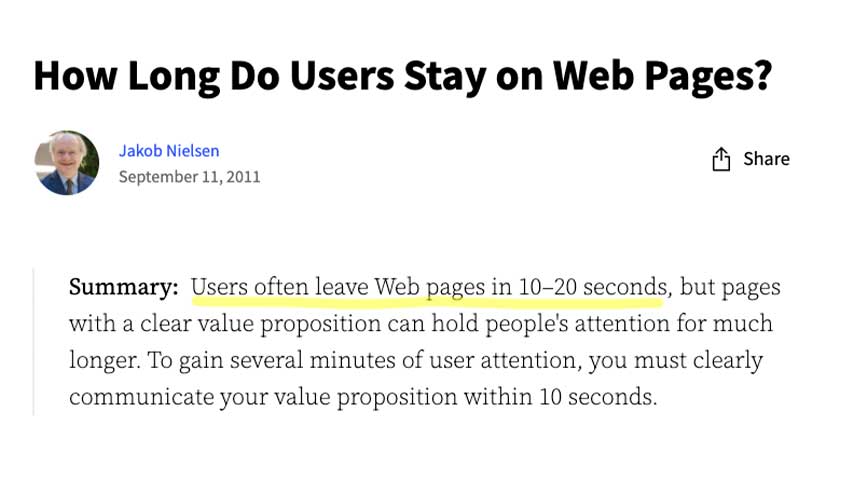
In fact, you only have 10 seconds to convey what you offer, and let’s be honest: If your customers are slapped with this login/register dialog, they’ll likely jump back to search results faster than you can say ‘lost business’.
Technically, you can also click the “x” button. But, what non-Facebook users see is still ‘not good.’
Let’s break down what non-Facebook users are missing out on:
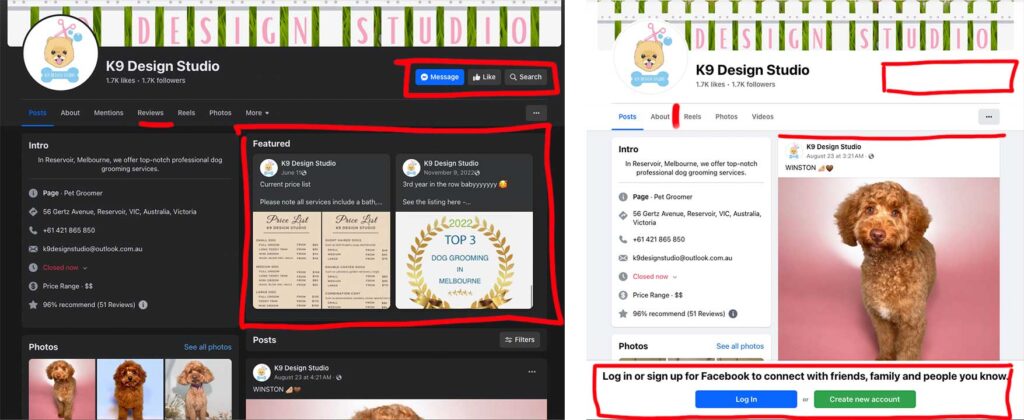
- No more featured posts, so no one will even see your amazing promotion.
- Instead of clear calls to action like ‘Book Now’ or ‘Shop,’ they see prompts to log in or sign up. Talk about a major buzzkill.
- Reviews? The lifeblood of local businesses? Missing in Action (MIA).
- And those beautiful, up-to-date photos showcasing your work? They’ll see the oldest photo instead of the newest one.
- The all-important ‘Message’ button? Vanished into thin air. Your potential customers can’t even reach out easily!
Ironically, Meta commissioned a study in 2016 that found 53% of people are more likely to shop with a business they can message directly. But as we’ve just discussed, non-Facebook users can’t really ‘message’ businesses through their app.
But here’s the million-dollar question:
How many people click away and choose your competitors instead?
Scary thought, right?
If you want to maximize conversions, switch to a custom website tailored to your business.
Book a Meeting Today!2. The mobile version of the Facebook page is 100% not built for businesses
Here’s the thing:
92.3% of people who surf the net are using their phones. I’m sure that’s true for both you and me. That’s too big of a number to ignore.
You see, the mobile version primarily focuses on getting users to log in; hence, the conversion optimization for your business is almost non-existent.
I explained and showed how frustrating it is in the video. You can watch it here.
Whether you’re logged in or not, Facebook’s design prioritizes keeping users on its platform rather than driving conversions for your business. The mobile experience is incredibly flawed, with buttons like “Like” overshadowing more critical actions like “Book Now” or “Shop.”
Friction-filled user journeys, from login prompts to cumbersome contact methods, create unnecessary barriers, increasing the risk of losing your potential clients/customers.
At this point, choosing between Facebook or website for business should be obvious now, right? Otherwise, keep on reading.
3. Unable to rank for the “golden” high-volume keywords
With a Facebook page, you could show up on Google with branded search, but not for lucrative high-volume keywords.
Let me hit you with some cold, hard numbers:
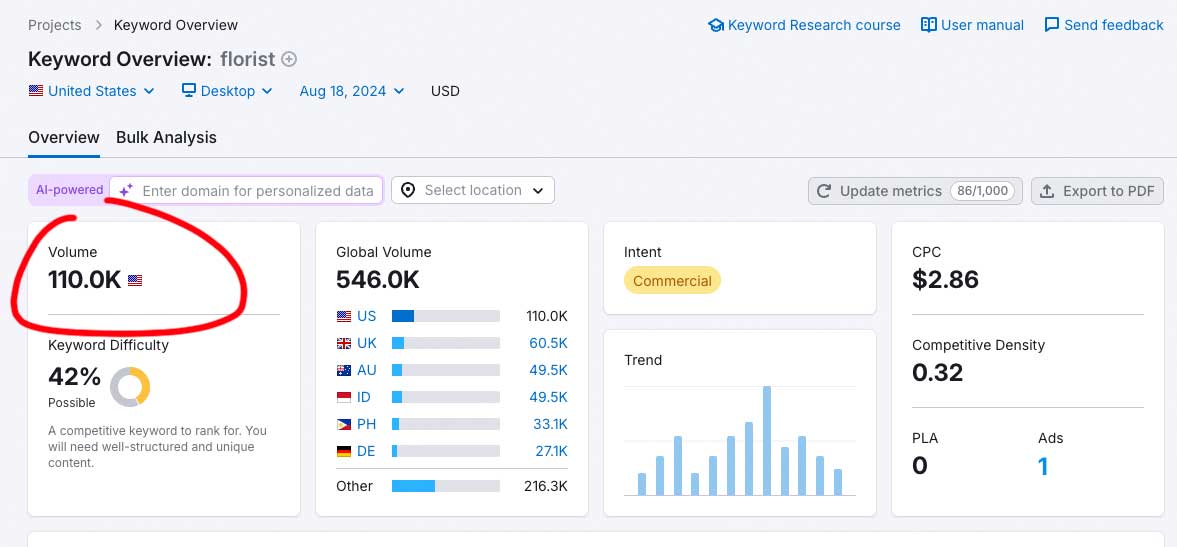
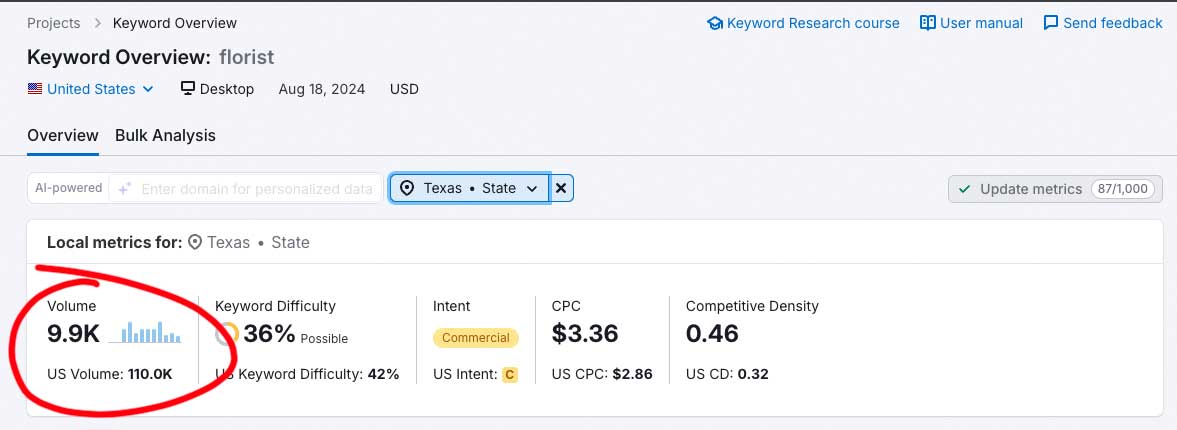
‘Florist in Texas’? Still impressive at 9,900.
But a specific brand like ‘Enchanted Florist’? (It’s a florist business in Texas.) A measly 320. TBH, this is actually a pretty good number for a local branded search.
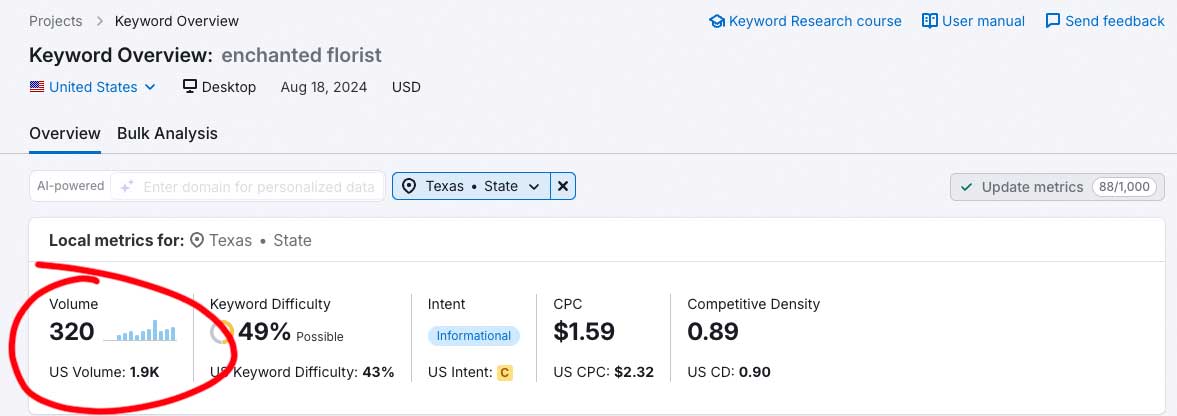
Let’s visualize that.
In the US, your brand is likely but a fraction of what you could be targeting.
Even if you’re only doing business in the Lone Star state, that’s still a sliver compared to what you could target. And the only way you can actually tap into the 96.9% is to have a website.
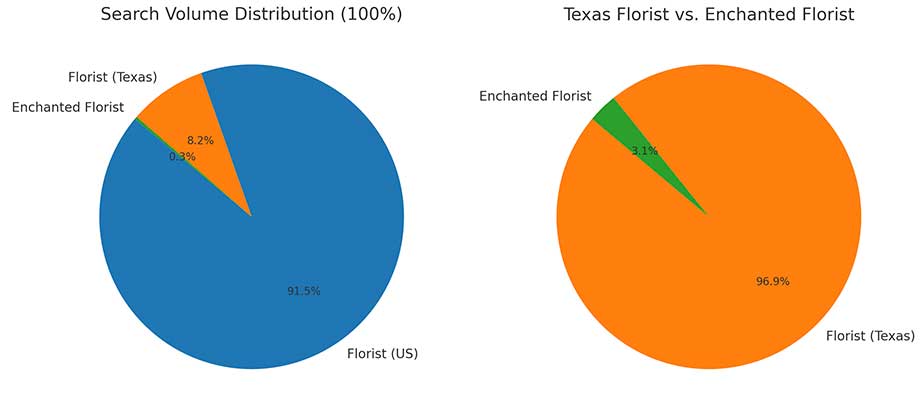
Basically, it’s extremely challenging to rank for a “Florist near me” keyword without a website. I only know this is possible if your city doesn’t have a competition. But if someone decides to compete with you and they built a website?
They can quickly and effortlessly overtake you in search rankings.
4. Your business’ goals and Facebook’s goals are NOT aligned.
Facebook is also a business, just like yours. (Although they’re a titan, and we’re puny humans.)
Their goal is to keep users glued to their platform, scrolling endlessly through a sea of content.
And guess what?
Your Facebook business page is just a teeny tiny drop in that ocean.
Think about it:
When someone lands on your Facebook page, they’re bombarded with distractions.
Distraction in this context is anything that pulls your customer/client’s attention away from taking action into doing business with you.
Notifications pinging, cute cat/dog videos all vying for attention. (That’s the first time I’ve used that word thanks thesaurus.)
I actually counted 13+ distractions even when they’re on your page.
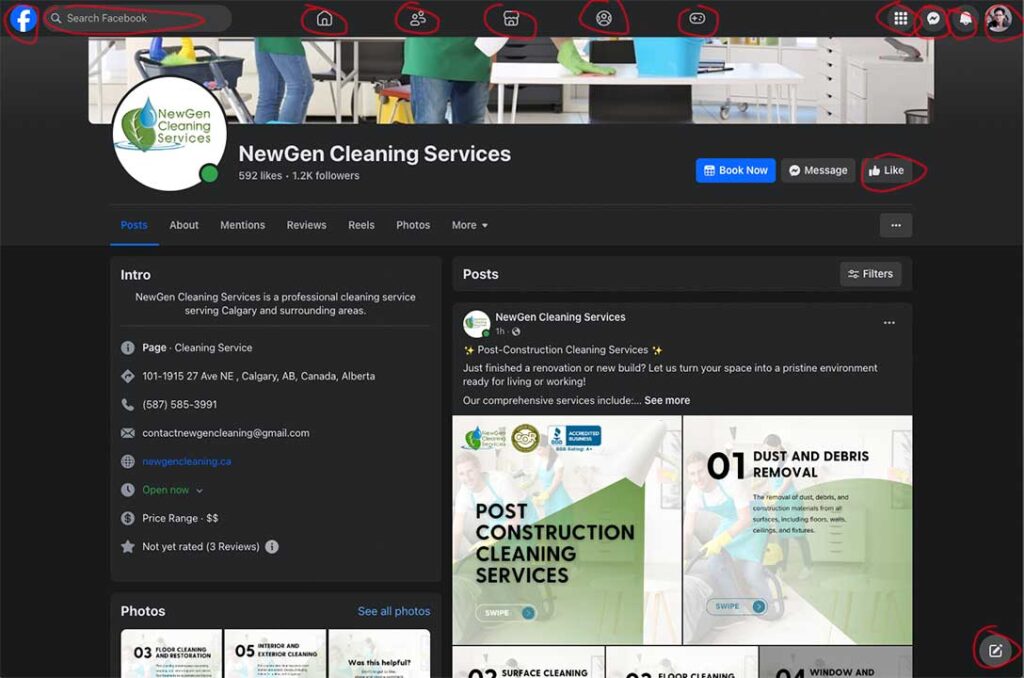
And if they click on any of those distractions, rather than “Book Now?” You’ve just lost a potential customer/client.
Compare that to a distraction-free website, where every design and layout decision is optimized for taking action.
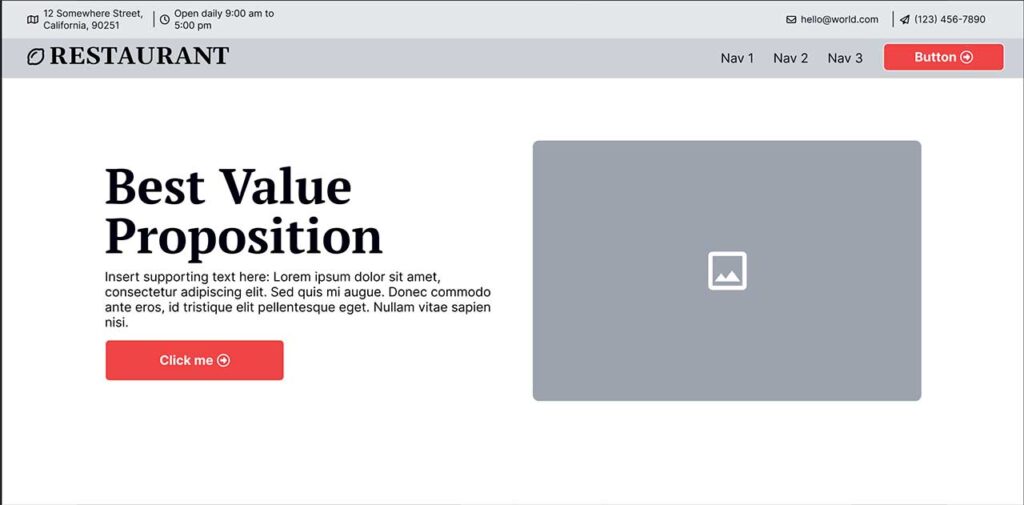
Besides, those distractions aren’t just about the design.
In the news feed? It gets worse.
You’re basically fighting against millions of businesses. You also need to consider their friends’ postings on social media, the reels portion, etc. It’s like trying to have a decent conversation in a loud nightclub.
Now, contrast that with 71% of businesses that have their websites. The competition? Significantly less (kind of).
Suddenly, standing out doesn’t seem like such an uphill battle, does it?
You know what else? Facebook’s engagement rates are abysmal. It’s actually only 0.15% according to Social Insider.
Say you post an incredible promotion, the best idea of your life. Well, only 1 in 667 followers will see it.
The only way around this is to pay for ads, but again, you’re still competing against other businesses with astronomical marketing budgets (compared to yours). You could say Facebook is pay-to-win.
Pro tip: Email marketing is the best option for promotional material, but that’s a story for another day.
Remember, the primary purpose of using Facebook, or social media, differs entirely from a search engine like Google. Facebook is more about socializing and passing the time. Whereas your potential customers/clients are over on Google, actively searching for solutions your business offers.
If you want to maximize conversions, switch to a custom website tailored to your business.
Book a Meeting Today!Let’s talk about digital real estate:
5. Visibility is currency;
Think of your online presence like fishing. Facebook? That’s like casting a single line into a bustling lake. Sure, you might catch something, but you’re leaving a lot to chance (skills & knowledge also play a factor in fishing, but I digress). Now, imagine casting a wide net covering that lake and the rivers and streams connected to it.
It’d be the biggest catch of your life. (Although using a net for sports fishing is illegal, don’t do it!)
The same is true for your business in the digital realm, but in this case, it’s legal to have a metaphorical net—which consists of your social media, listings, and, most importantly, your website.
Picture this:
Your business shows up in a Google search. But it’s not just your website that appears. It’s your website, your Google Business Profile listing, your social media profiles, and maybe even some reviews or articles mentioning your business. Suddenly, you’re not just a result – you’re dominating the page!
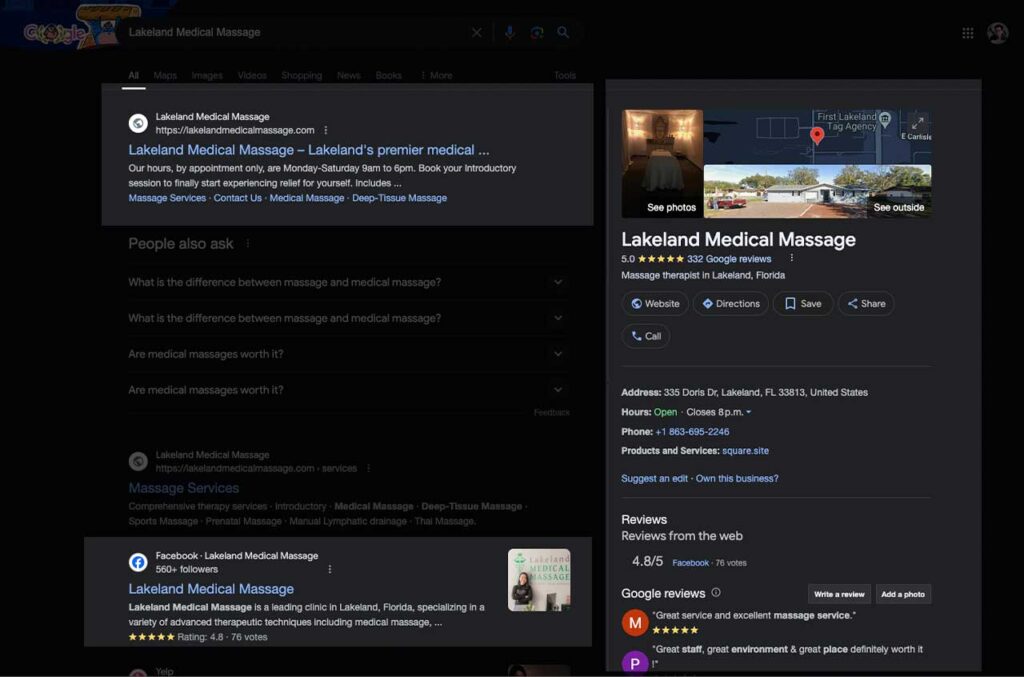
And here’s the kicker:
These digital properties work together, creating a network that catches customers no matter where they’re swimming in the vast online ocean. Your website acts as your home base, while platforms like Facebook serve as outposts, each playing a crucial role in your digital ecosystem.
Remember, the more ground you cover in the digital world, the more customers you’ll reel in.
So, ask yourself: Are you fishing with a single line or casting a net covering the entire digital sea? Because in this game, the biggest and most catches go to those with the widest reach.
Okay, that’s it for the fishing analogies; let’s move on to the next.
6. Facebook page isn’t enough when it comes to credibility.
Picture this:
You’re about to make a purchase with a new business you just discovered.
What’s the first thing you do? If you’re like me, you hop on Google faster than you can say, ‘Is this legit?’
Now, imagine your potential customers doing the same. They search for your business and… crickets. No website in sight. Just a lonely Facebook page.
When this happens, I’m out. Gone. Sayonara. And I’m not alone in this digital trust issues club either. According to CIRA, 26% of consumers don’t trust a business without a website. Let that sink in for a moment.
Now, let’s put some real numbers to this. Imagine you’re in a city of 100,000 people, and they’re all your potential customers*.
*Just an example, I still agree with the philosophy of, “if you sell to everyone, you sell to no one.”
Without a website, 26,000 people won’t even give your unique products or services a chance.
Ask yourself:
Can your business afford to lose more than a quarter of its potential customers before they even know what you offer?
7. You don’t have complete control over your Page.
First, branding.
Your carefully crafted business image? It’s reduced to a profile picture and a cover photo on Facebook. Everything else is Facebook blue. Your unique colour scheme and design elements are benched.

But that’s just the start. The real issue? Uniformity and limitations.
Every Facebook page looks the same – yours, mine, our competitors’, everyone’s. Standing out becomes a real challenge.
And optimizations for SEO or conversion? Forget about it. Facebook handles the SEO for your page; you don’t have a say. This is another reason why using the lucrative keywords we discussed earlier is nearly impossible.
Want to highlight your ‘Buy Now’ button? Facebook decides what goes where, so your most important information might end up buried.
Now, here’s the scary part:
Your entire online presence is at Facebook’s mercy. One misstep, one misunderstanding, or one overzealous competitor report could vanish your page without warning.
Let’s be clear:
You could spend countless hours perfecting your Facebook page, only to have it unapproved or taken down without explanation. It’s a chilling thought for any business owner.
And support? Good luck. It’s a maze of automated responses and generic solutions, which could take days, weeks, or months (maybe) before you can get your concern addressed.
To be fair to Meta, this makes sense, considering their colossal number of users. Can you imagine handling thousands of support tickets every day? Jeez.
Compare this to having your website.
Hacked? Your agency, hosting provider, or freelancer can help you recover your website quickly*. Need to change your layout? It’s your website—you decide.
*depends on your service provider
The bottom line? Relying solely on Facebook to get clients/customers is dangerous. You’re always one policy change or algorithm update away from potential disaster.
Ask yourself:
Are you comfortable putting your entire online presence in Meta’s hands? Or is it time to take control of your digital destiny?
Bottom Line, Facebook or Website?
Both, you should have both Facebook AND website, to make sure your business takes off.
And, as mentioned earlier, I’m not saying Facebook is ‘bad’ for your business; in fact, it’s also a must-have. The point is you shouldn’t rely on it ALONE. Simply put, don’t put all your eggs in one basket.
You can imagine your website as your physical store. Facebook (and other social media) may be the billboard ads or word of mouth, but the physical store (website) is where they’ll actually interact with your business.
So, if you’re serious about growing your business and making a splash online, it’s time to consider getting a website. It’s not just some fancy add-on—it’s an investment in making your brand look legit and easy to find.